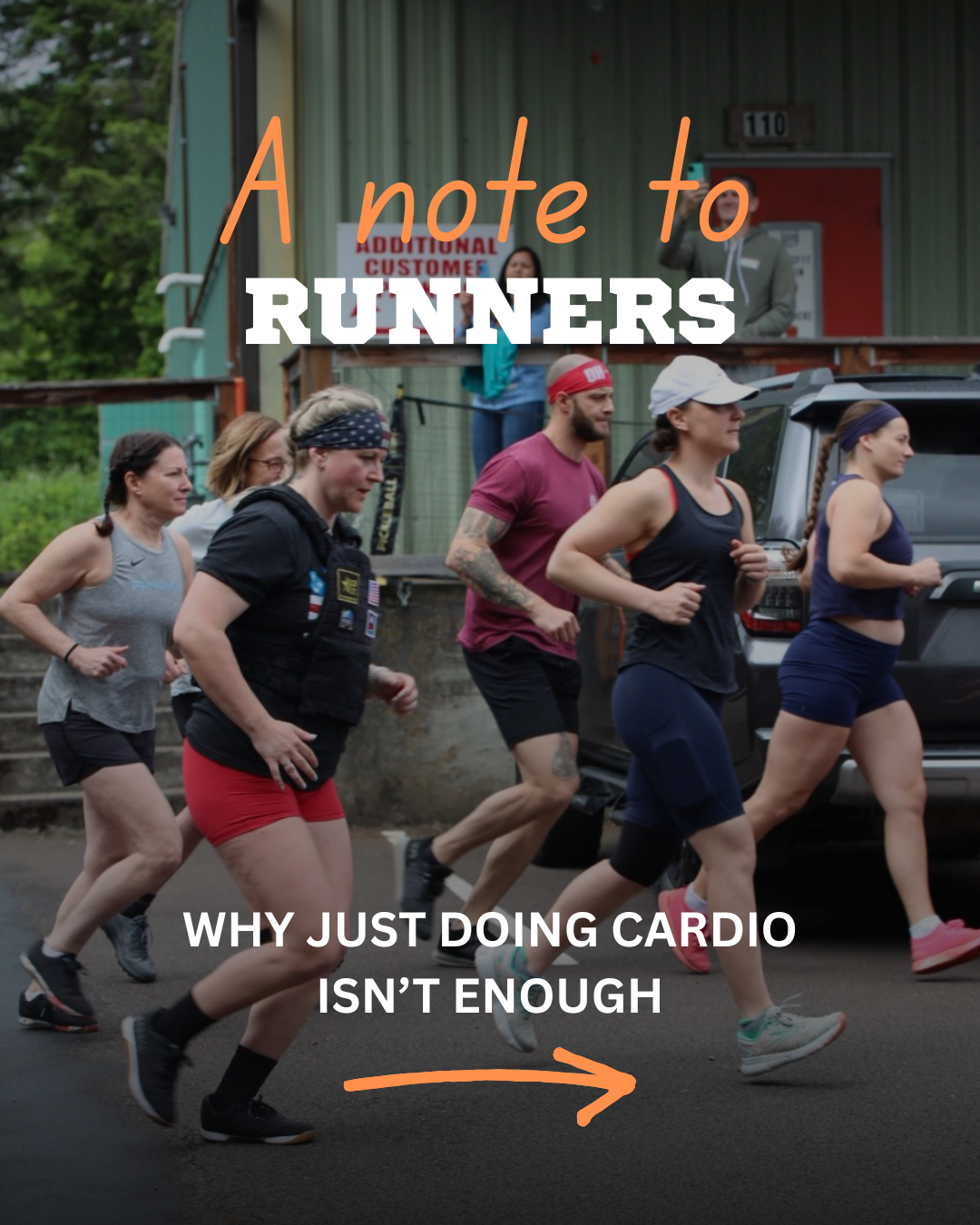
This is the conversation that tends to create the most friction and the most converts. Because almost everyone comes into CrossFit with a story about cardio. They run. They bike. They swim. They’ve been told for years that steady-state aerobic work is the foundation of health and fitness. And they’re not entirely wrong.
But they’re not entirely right, either. The “Metabolic Conditioning” article laid out the science behind CrossFit’s approach to “cardio,” why intensity beats duration, why anaerobic training does things aerobic training can’t, and what the research actually says about the most efficient path to cardiovascular fitness. We’ve put it in conversation form because this particular topic deserves to be argued out loud. Read it, then go find your favorite distance runner and have the conversation yourself.
“I run five days a week. My heart rate is great, and my weight is under control. Why would I need to change anything?”
I’m not here to tell you running is bad. It’s not. But let me ask you something: when you say your heart rate is great, what are you comparing it to? Because cardiovascular health isn’t one number; it’s a full picture. And if the only thing you’re training is your aerobic system, you’re getting one piece of that picture. A pretty good piece, sure. But one piece.
“What am I missing?”
Your body has three ways to produce energy, and if you’ve read the earlier articles in this series, you’ve met them already. The phosphagen system for short explosive efforts, the glycolytic system for moderate-intensity work, and the oxidative system for sustained aerobic efforts like your runs. Most people think “cardio” means training the third one. CrossFit trains all three. If you’re only running, you’re only training one energy system, and the other two are quietly deteriorating.
“But I feel fit. I can run for hours. How is that not fitness?”
It’s a form of fitness. A real one. But here’s a question: can you sprint? Can you pick something heavy up off the ground without your back complaining? Can you do 10 pull-ups? Those things require capacities your running isn’t building. And in some cases, your running may actually be working against them. Excessive aerobic training eats muscle and reduces strength and speed. It’s not a theory; you can see it just by comparing the physique of a sprinter to a marathoner. Same sport, different distance, completely different body. That difference is a direct result of how each person trains.
“That feels a little harsh toward endurance runners. Are you saying long runs are bad?”
I’m saying they have a cost that most people don’t account for. Long, slow aerobic work improves endurance. It also reduces power, speed, and strength over time if it’s all you do. For a dedicated distance athlete who only needs endurance, that trade-off might make sense. For people who want to be strong, fast, capable, and healthy across a full range of physical demands over the course of their entire lives, it doesn’t. You’re paying a price for a benefit you could get another way, without the trade-off.
“What other way?”
Interval training. High-intensity work alternated with real rest. Short bursts, hard effort, recover, repeat. This is anaerobic training with structure, and the research behind it is genuinely remarkable. A researcher named Dr. Izumi Tabata tested a protocol: 20 seconds of all-out work, 10 seconds of rest, repeated eight times. Four minutes total. His results showed significant improvements in both anaerobic and aerobic capacity. More importantly, his high-intensity group outperformed a group doing 60 minutes of moderate steady-state work on VO2 max — the gold standard measure of cardiovascular fitness. Four minutes beat 60. That’s significant.
“That sounds too good to be true. Four minutes can really replace an hour of cardio?”
The research says yes, under the right conditions. And before you dismiss it, this wasn’t a fringe study or a fitness industry claim. It was published in a peer-reviewed journal and has been replicated and built upon since. The mechanism makes sense, too — high-intensity anaerobic effort stresses the cardiovascular system at least as much as sustained aerobic work, often more. Your heart doesn’t know whether you’re sprinting or jogging. It knows how hard it’s working. Intervals make it work very hard, adapting without the muscle loss that comes from long-duration aerobic training.
“So, CrossFit is basically just interval training?”
It includes interval training, but it’s bigger than that. The key is variation across modalities; not just varying the intensity of one thing, but training completely different movements, skills, and time domains. Running intervals, rowing intervals, lifting, gymnastics, bodyweight work. Every time you shift to a new modality, your body faces a new cardiovascular stimulus and has to adapt again. Stack those adaptations across dozens of different physical demands, and you get a cardiovascular system that’s broad and robust — not just good at running or biking or rowing, but good at all of it. And at things you haven’t specifically trained for, which is where it really counts.
“What’s the actual evidence that this works for endurance specifically? I’m a runner, and I care about running.”
Here’s one that tends to surprise people: CrossFit athletes have improved their endurance performance without doing endurance training. And police training programs that replaced distance-run-based conditioning with CrossFit found that recruits actually posted better run times than the groups that had been running all along. Not despite the absence of long runs but because of what replaced them. The broad fitness base transfers directly to endurance performance.
“What would I actually feel different doing CrossFit versus my current training?”
Power. The most immediate thing people notice is the ability to produce force quickly. To sprint, to jump, to move something heavy fast. Running doesn’t give you that. CrossFit does. And then over time, you’d notice that your running doesn’t suffer. Your times don’t drop. In most cases, they improve because your engine is bigger, your body is stronger, and you’re drawing on capacities that a single-modality program never built. Think of it like this: a slow, fuel-efficient car and a fast, powerful one can cover the same distance. But only one of them can do everything else you’d want a car to do.
“But can I still run?”
Absolutely. Plenty of CrossFit athletes run. The question is whether running is the whole program or part of one. Come in, try a few workouts, and see what you notice. My guess is that within a few weeks, you’ll start to feel capacities you didn’t know you were missing. And once you feel them, you won’t want to give them up.
Ready to find out what you’ve been missing? Find a CrossFit gym near you.
Closing Note
If you made it through all four of these conversations, you’ve just done something most people rarely do: you challenged your own thinking, opinions, and beliefs.
That matters. Not because the concepts are complicated, but because it’s easy to show up, do the work, and never fully connect what you’re doing to why it works. The whiteboard makes sense. The movements make sense. The soreness the next day definitely makes sense. But the deeper logic and the framework underneath all of it is what separates people who do CrossFit from people who truly understand it. And understanding it changes how you train.
You chase intensity differently when you know why intensity is the variable that matters. You stop dreading the movements you’re worst at when you understand that those are exactly the ones making you better. You stop asking, “What’s the point of this workout?” because you already know: it’s building capacity you don’t have yet in a domain you haven’t fully trained.
That’s the gift in these articles. Not information but perspective. And perspective compounds the same way fitness does. Come back to these again in a year. You’ll be a different athlete, and something new will land.
Now get out there and train.