What is Fitness? Part 6

Spring Apparel Order is Live!

All Items are PRE-ORDER ONLY.

There may not be any extras ordered, so if you want these items you have got to order them now!

Orders are due by Sunday April 14th.

Online Store: https://squareup.com/store/crossfit-train-97333


WOD: 04/10/19

EMOTM for 20 minutes:
Odd: Deadlift, 2 reps
Even: L-sit, 20 seconds


WHAT IS FITNESS?

By Greg Glassman

Metabolic Conditioning, or “Cardio”

Biking, running, swimming, rowing, speed skating and cross-country skiing are collectively known as “metabolic conditioning.” In the common vernacular they are referred to as “cardio.” CrossFit’s third fitness model, the one that deals with metabolic pathways, contains the seeds of the CrossFit “cardio” prescription. To understand the CrossFit approach to “cardio” we need first to briefly cover the nature and interaction of the three major pathways.

Of the three metabolic pathways the first two, the phosphagen and the glycolytic, are “anaerobic,” and the third, the oxidative, is “aerobic.” We needn't belabor the biochemical significance of aerobic and anaerobic systems; suffice it to say that understanding the nature and interaction of anaerobic exercise and aerobic exercise is vital to understanding conditioning. Just remember that efforts at moderate to high power and lasting less than several minutes are anaerobic and efforts at low power and lasting in excess of several minutes are aerobic. As an example, the sprints at 100, 200, 400, and 800 meters are largely anaerobic, and events such as 1,500 meters, the mile, 2,000 meters and 3,000 meters are largely aerobic.

Aerobic training benefits cardiovascular function and decreases body fat—all good. Aerobic conditioning allows us to engage in low-power extended efforts efficiently (cardio/respiratory endurance and stamina). This is critical to many sports. Athletes engaged in sports or training where a preponderance of the training load is spent in aerobic efforts witness decreases in muscle mass, strength, speed and power. It is not uncommon to find marathoners with a vertical leap of only several inches! Furthermore, aerobic activity has a pronounced tendency to decrease anaerobic capacity. This does not bode well for most athletes or those interested in elite fitness.

Anaerobic activity also benefits cardiovascular function and decreases body fat! In fact, anaerobic exercise is superior to aerobic exercise for fat loss! Anaerobic activity is, however, unique in its capacity to dramatically improve power, speed, strength and muscle mass. Anaerobic conditioning allows us to exert tremendous forces over brief time intervals. One aspect of anaerobic conditioning that bears great consideration is that anaerobic conditioning will not adversely affect aerobic capacity. In fact, properly structured, anaerobic activity can be used to develop a very high level of aerobic fitness without the muscle wasting consistent with high volumes of aerobic exercise! The method by which we use anaerobic efforts to develop aerobic conditioning is “interval training.”

Basketball, football, gymnastics, boxing, track events under one mile, soccer, swimming events under 400 meters, volleyball, wrestling and weightlifting are all sports that require the vast majority of training time spent in anaerobic activity. Long-distance and ultra-endurance running, cross-country skiing, and 1,500+ meter swimming are all sports that require aerobic training at levels that produce results unacceptable to other athletes or the individual concerned with total conditioning and optimal health.

We strongly recommend that you attend a track meet of nationally or internationally competitive athletes. Pay close attention to the physiques of the athletes competing at 100, 200, 400 and 800 meters and the milers. The difference you are sure to notice is a direct result of training at those distances.

Article borrowed from https://journal.crossfit.com/article/what-is-fitness

Derek Eason
Meal Prep

WOD: 04/08/19

“A Whole Lotta Tabata”

Tabata Row for Calories
Tabata Double-unders

Rest 2 minute

Tabata Toes to Bar
Tabata Sit-ups

Rest 2 minute

Tabata Ring Rows
Tabata Ring Push-ups


Do you even MEAL PREP, bro?

Guest Blog by Rebecka Weinsteiger 

It took me a while to figure out meal prepping and it wasn’t until I was struggling through the learning curve of understanding Renaissance Periodization and IIFYM (If it fits your macros) meal planning – until it clicked.  And it clicked. I now have more free-time in my week and my family eats healthier.  I didn’t think it was possible. 

I have been batch cooking and packing lunches for years, but I wasn’t tracking what I was eating.  So that worked in a way that I was saving money because I wasn’t going to the Baguette to grab a couple of spring rolls for lunch, but I wasn’t seeing and gains… or losses, if you know what I mean. 

Renaissance Periodization is meal plan that calculates the exact amount of macronutrients: protein, carbs, and fats you need to eat at each meal, and when each meal should be had.  The only way I could figure out how to work this program into my life was to simply my meal plan.  My weekly meal plan changed from recipes (throwing whatever food I had into a curry or chicken soup or stir-fry) to a meat, a veg, and carb. 

Every Saturday I take meat out of the freezer to defrost.  For protein, our family loves chicken thighs, burgers, steak, pork loin, pork roast.  On Sunday I grill 3-4 pounds of burgers, 2 packages of chicken thighs, a steak and maybe a loin. I season and put a roast in the instant pot.  For carbs, I cook a big pot of rice, steam a big pot of sweet potatoes and over the winter I pressure cooked big hearty earthy winter squash in the instant pot.  I buy local frozen spinach in bulk (15 pounds at a time from the First Alternative Co-op).  I also squirrel away sale frozen veggies whenever I can. Buy one get one, count me in!  For seasoning I sauté market fresh forage mushrooms with onions and garlic. 

Once all the cooked foods have cooled to room temp, I portion them in plastic containers with 3 cells.  I measure out the suggested amount of protein, and carbs and about three handfuls of frozen vegs into about 10 containers.  What about the fat? I assume that any fat allotment given, would be dedicated to the fat in the meat, but sometimes I add truffle butter to my squash or top my meals with the wild mushroom sauté.  I eat breakfast, lunch and sometimes dinner at work.  All left-over meat goes into see-through glass containers to store in my fridge for easy grab and go family meal prep and school lunches. 

This has saved me so much time, and I have become pretty experienced grill-master. My kids eat better.  Now choosing a quick meal like reheating chicken, broccoli and rice is just as easy as making mac and cheese.  I use to pack a pb-n-j every day in my kids lunch, and now I just reheat rice, meat and a veg and store it in a thermos.   

For extra flavor and extra food (sometimes I am HUNGRY) I add two tablespoons of sauerkraut.  Fermented cabbage comes in every flavor now and packs a punch.  I add to salad instead of dressing.  Crazy?  I know.  If you are looking for a way to make the healthy option the easy option, I highly recommend you consider meal prepping! 

Stay tuned for a post about Renaissance Periodization soon!


Rebecka Weinsteiger has been wodding at Crossfit Train since July 2013 and still loves it.  You can find her at 6am usually and on the weekends. 


Derek Eason
Sunday Funday

WOD: 04/07/19


Arnie
With a single kettlebell:
21 Turkish get-ups, Right arm
50 Swings
21 Overhead squats, Left arm
50 Swings
21 Overhead squats, Right arm
50 Swings
21 Turkish get-ups, Left arm

Derek Eason
Saturday Stations!

WOD: 04/06/19


Saturday Stations

5 rounds of:
1 minutes Max reps at:

Wall-balls, 20/14-lbs.

Alternating Dumbbell Snatches, 50/35-lbs.

Toes to Bar

Row for Calories

Rest

Derek Eason
What is Fitness? Part 5

BE THERE!

WOD: 04/05/19


Power clean 5-3-3-1-1-1 reps.

3 rounds for time of:
15 Power Cleans, 135/95-lbs.
15 Ring Dips

WHAT IS FITNESS?

By Greg Glassman

Implementation

Our fitness, being “CrossFit,” comes through molding men and women that are equal parts gymnast, Olympic weightlifter and multi-modal sprinter or “sprintathlete.” Develop the capacity of a novice 800-meter track athlete, gymnast and weightlifter and you will be fitter than any world-class runner, gymnast or weightlifter.

Next let us look at how CrossFit incorporates metabolic conditioning (“cardio”), gymnastics and weightlifting to forge the world’s fittest men and women.

Article borrowed from https://journal.crossfit.com/article/what-is-fitness

Derek Eason
What is Fitness? Part 4

Be there.

WOD: 04/04/19


Rowboat Cindy

3 rounds Each For Time of:
Row 1000m
5 rounds of “Cindy”

WHAT IS FITNESS?

By Greg Glassman

Common Ground

The motivation for the three standards is simply to ensure the broadest and most general fitness possible. Our first model evaluates our efforts against a full range of general physical adaptations. In the second, the focus is on breadth and depth of performance. With the third, the measure is time, power and consequently energy systems. It should be fairly clear that the fitness CrossFit advocates and develops is deliberately broad, general and inclusive. Our specialty is not specializing. Combat, survival, many sports and life reward this kind of fitness and, on average, punish the specialist.

Sickness, Wellness and Fitness

There is another aspect to the CrossFit’s fitness that is of great interest and immense value to us. We have observed that nearly every measurable value of health can be placed on a continuum that ranges from sickness to wellness to fitness. Though tougher to measure, we would even add mental health to this observation. Depression is clearly mitigated by proper diet and exercise; i.e., genuine fitness.

For example, a blood pressure of 160/95 is pathological, 120/70 is normal or healthy, and 105/55 is consistent with an athlete’s blood pressure; a body fat of 40 percent is pathological, 20 percent is normal or healthy, and 10 percent is fit. We observe a similar ordering for bone density, triglycerides, muscle mass, flexibility, HDL or “good cholesterol,” resting heart rate and dozens of other common measures of health. Many authorities (e.g. Mel Siff, the NSCA) make a clear distinction between health and fitness. Frequently they cite studies that suggest that the fit may not be health protected. A close look at the supporting evidence invariably reveals the studied group is endurance athletes and, we suspect, endurance athletes on a dangerous fad diet (high carbohydrate, low fat, low protein).

Done right, fitness provides a great margin of protection against the ravages of time and disease. Where you find otherwise, examine the fitness protocol, especially diet. Fitness is and should be “super-wellness.” Sickness, wellness and fitness are measures of the same entity. A fitness regimen that does not support health is not CrossFit.

(As a note of interest, Siff, whom we often respect and admire, holds his atherosclerotic disease and subsequent heart attack as anecdotal evidence of the contention that fitness and health are not necessarily linked because of his regular training and “good diet.” When we researched his dietary recommendations, we discovered that he advocates a diet ideally structured for causing heart disease — low fat/high carb. Siff has fallen victim to junk science!)

Figure 2: The Sickness-Wellness-Fitness Continuum.

Article and image borrowed from https://journal.crossfit.com/article/what-is-fitness

Derek Eason
What is Fitness? Part 3

WOD: 04/03/19


Deadlift 5-3-3-1-1-1 reps
(80%, 85%, 90%)


For time:
3:00 Handstand Hold
21 Dumbbell Burpee Deadlifts, 50/35-lbs.
2:00 Handstand Hold
15 Dumbbell Burpee Deadlifts
1:00 Handstand Hold
9 Dumbbell Burpee Deadlifts

WHAT IS FITNESS?

By Greg Glassman

CrossFit’s Second Fitness Standard

The essence of this model is the view that fitness is about performing well at any and every task imaginable. Picture a hopper loaded with an infinite number of physical challenges, where no selective mechanism is operative, and being asked to perform feats randomly drawn from the hopper. This model suggests that your fitness can be measured by your capacity to perform well at these tasks in relation to other individuals.

The implication here is that fitness requires an ability to perform well at all tasks, even unfamiliar tasks and tasks combined in infinitely varying combinations. In practice this encourages the athlete to disinvest in any set notions of sets, rest periods, reps, exercises, order of exercises, routines, periodization, etc. Nature frequently provides largely unforeseeable challenges; train for that by striving to keep the training stimulus broad and constantly varied.

CrossFit’s Third Fitness Standard

There are three metabolic pathways that provide the energy for all human action. These “metabolic engines” are known as the phosphagen (or phosphocreatine) pathway, the glycolytic (or lactate) pathway and the oxidative (or aerobic) pathway. The first, the phosphagen, dominates the highest-powered activities, those that last less than about 10 seconds. The second pathway, the glycolytic, dominates moderate-powered activities, those that last up to several minutes. The third pathway, the oxidative, dominates low-powered activities, those that last in excess of several minutes.

Total fitness, the fitness that CrossFit promotes and develops, requires competency and training in each of these three pathways or engines. Balancing the effects of these three pathways largely determines the how and why of the metabolic conditioning or “cardio” that we do at CrossFit.

Favoring one or two to the exclusion of the others and not recognizing the impact of excessive training in the oxidative pathway are arguably the two most common faults in fitness training. More on that later.

Figure 1: The metabolic pathways’ contribution of total energy versus time.

Article and image borrowed from https://journal.crossfit.com/article/what-is-fitness

Derek Eason
What is Fitness? Part 2

WOD: 04/02/19


“Shot Put”

30-25-20-15-10-5 reps for time of:
Med-ball Cleans, 20/14-lbs.
Step-ups with Med-ball, 24”/20”
Sit-ups with the Med-ball

What is Fitness?

By Greg Glassman

CrossFit’s First Fitness Standard

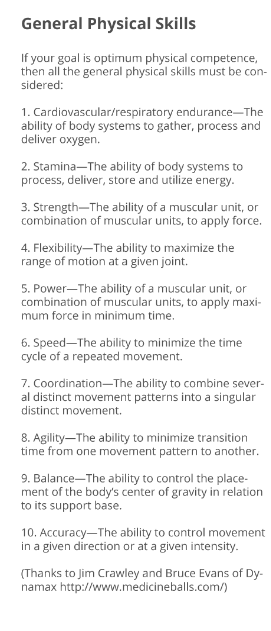
There are 10 recognized general physical skills. They are cardiovascular/respiratory endurance, stamina, strength, flexibility, power, speed, coordination, agility, balance and accuracy. You are as fit as you are competent in each of these 10 skills. A regimen develops fitness to the extent that it improves each of these 10 skills.

Importantly, improvements in endurance, stamina, strength and flexibility come about through training. Training refers to activity that improves performance through a measurable organic change in the body. By contrast, improvements in coordination, agility, balance and accuracy come about through practice. Practice refers to activity that improves performance through changes in the nervous system. Power and speed are adaptations of both training and practice.

Article and image borrowed from https://journal.crossfit.com/article/what-is-fitness

Derek Eason
What is Fitness? Part 1

WOD: 04/01/19

“Indiana Jones”
20 Minute AMRAP of:
1 Rope Climb
10 DB Hang Clean and Jerk, Right Arm, 50/35-lbs.
50 Double-unders
1 Rope Climb
10 DB Hang Clean and Jerks, Left Arm, 50/35-lbs.
50 Double-unders

What is Fitness?

By Greg Glassman

What is fitness and who is fit?

In 1997, Outside Magazine crowned triathlete Mark Allen “the fittest man on Earth.” Let us just assume for a moment that this famous six-time winner of the IronMan Triathlon is the fittest of the fit. Then what title do we bestow on the decathlete Simon Poelman, who also possesses incredible endurance and stamina yet crushes Mr. Allen in any comparison that includes strength, power, speed and coordination?

Perhaps the definition of fitness does not include strength, speed, power and coordination, though that seems rather odd. Merriam Webster’s Collegiate Dictionary defines “fitness” and being “fit” as the ability to transmit genes and being healthy. No help there. Searching the Internet for a workable, reasonable definition of fitness yields disappointingly little. Worse yet, the National Strength and Conditioning Association (NSCA), the most respected publisher in exercise physiology, in its highly authoritative "Essentials of Strength Training and Conditioning," does not even attempt a definition.

CrossFit’s Fitness

For CrossFit, the specter of championing a fitness program without clearly defining what it is that the program delivers combines elements of fraud and farce. The vacuum of guiding authority has therefore necessitated that CrossFit provide its own definition of fitness. That is what this article is about: our “fitness.”

Our pondering, studying, debating about and finally defining fitness have played a formative role in CrossFit’s successes. The keys to understanding the methods and achievements of CrossFit are perfectly embedded in our view of fitness and basic exercise science.

It will come as no surprise to most of you that our view of fitness is a contrarian view. The general public both in opinion and in media holds endurance athletes as exemplars of fitness. We do not. Our incredulity on learning of Outside’s awarding a triathlete the title of “fittest man on Earth” becomes apparent in light of CrossFit’s models for assessing and defining fitness.

CrossFit makes use of three different standards or models for evaluating and guiding fitness. Collectively, these three standards define the CrossFit view of fitness. The first is based on the 10 general physical skills widely recognized by exercise physiologists. The second standard, or model, is based on the performance of athletic tasks, while the third is based on the energy systems that drive all human action.

Each model is critical to CrossFit, and each has distinct utility in evaluating an athlete’s overall fitness or a strength-and-conditioning regimen’s efficacy. Before explaining in detail how each of these three perspectives works, it warrants mention that we are not attempting to demonstrate our program’s legitimacy through scientific principles. We are but sharing the methods of a program whose legitimacy has been established through the testimony of athletes, soldiers, cops and others whose lives or livelihoods depend on fitness.


Article borrowed from https://journal.crossfit.com/article/what-is-fitness

Derek Eason