WOD: 06/22/19
Double TABATA
16 rounds of :20 on / :10 off of:
Air Squats
Sit-ups
Rest 1 minute
Pull-ups
Push-ups
Rest 1 minute
Handstand Hold
Plank Hold
Rest 1 minute
Toes to Bar
Burpees to the Bar
WOD: 06/22/19
Double TABATA
16 rounds of :20 on / :10 off of:
Air Squats
Sit-ups
Rest 1 minute
Pull-ups
Push-ups
Rest 1 minute
Handstand Hold
Plank Hold
Rest 1 minute
Toes to Bar
Burpees to the Bar
WOD: 06/21/19
3 rounds Each for Time of:
Row 50 Calories
Run 400m
*Rest as needed between sprints.
By Greg Glassman
Adapted from Coach Glassman’s Dec. 1, 2007, L1 lecture in Charlotte, North Carolina, and originally published in the CrossFit Level 1 Training Guide.
By taking power or work capacity as our primary value for assessing technique—and this reliance on functional movement—we end up in kind of an interesting position. We end up where power is the successful completion of functional movement.
This is not about merely energy exerted. On a graph, you could put work accomplished on the Y-axis and energy expended on the X-axis. Someone could potentially expend a lot of energy and do very little work by being inefficient. Ideally, what that individual would do would see little energy expended for the maximum amount of work. Technique is what maximizes the work completed for the energy expended (Figure 1). For any given capacity, say metabolically, for energy expenditure, the guy who knows the technique is going to be able to do the most amount of work.
Suppose I take two people at random and they are both trying the same task. One is familiar with how to deadlift, and one is not. One knows how to clean, one does not. One knows how to drive overhead, one does not. Suppose they are loading a truck with sandbags. The one familiar with lifting large objects and transporting them is going to do a lot more work.
You can have the argument as to who is stronger. For example, you can use an electromyogram and see with what force the biceps shortens. If you are defining strength as contractile potential, you may end up with the guy with enormous contractile potential—but not knowing the technique of the clean, the jerk, the deadlift, he cannot do as much work.
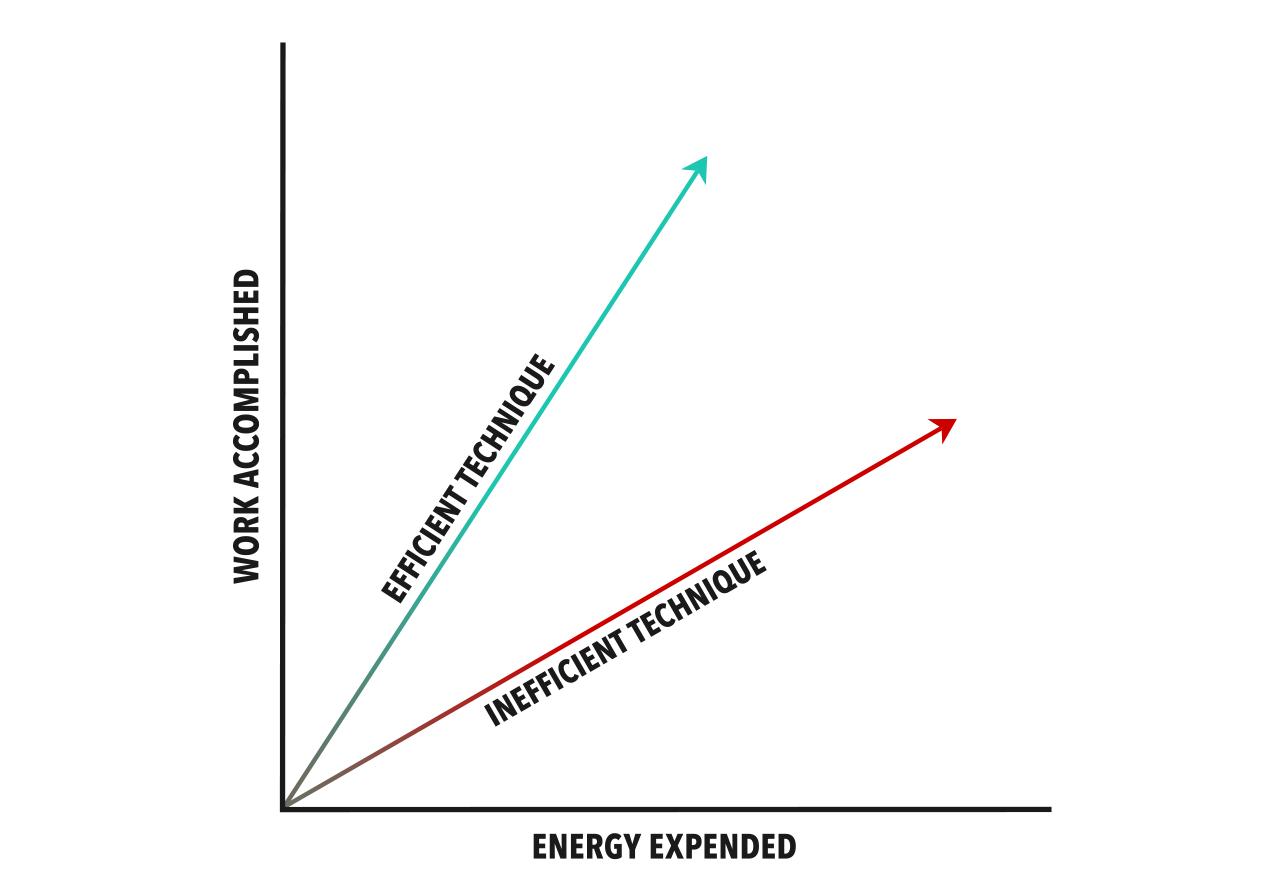
Figure 1: Technique maximizes the work accomplished for the energy expended.
We, however, do not take contractile potential as the gold standard for strength. Strength is the productive application of force. If you cannot complete work, if you cannot express strength as power, if strength cannot be expressed as productive result, it does not count. Having enormous biceps and quadriceps is useless if you cannot run, jump, lift, throw, press.
This is related to safety, efficacy and efficiency because technique (quality of movement) is the heart of maximizing each of these.
He or she who knows how to do these movements when confronted with them will get a better result in terms of safety. Two individuals attempt to lift a heavy object; one knows how to pop a hip and get under it (clean), and the other guy starts to pull with a rounded back. I can tell you what is likely to happen to he or she who does not know how to lift. If you want to stay safe, you better have good technique, good form.
Efficacy, for any given contractile potential, for any given limit to your total metabolic capacity, he or she who knows the technique will be able to get more work done and will develop faster. If after six months of teaching you how to clean it still does not look like I would like it to, you will not get twice body weight overhead more quickly someone who looks like a natural. You want an effective program, you are going to have to move with quality, you want to get the result quickly—technique is going to be pivotal to your success.
Technique is an intimate part of safety, efficacy, and efficiency.
We can see how this manifests in CrossFit workouts by way of a comparison. I want to look at typing, shooting, playing the violin, NASCAR driving and CrossFit. What these domains have in common is that a marked proficiency is associated with speed. Being able to shoot accurately and quickly is better than quickly or accurately.
You may try to get a job as a typist because you do not make any mistakes. However, for this perfection, you type at a rate of 20 words a minute and only use two fingers. You will never get hired. Playing the violin fast and error-free is critical for a virtuoso. However, someone who gets through “Flight of the Bumblebee” in 12 minutes is not there yet. A NASCAR driver wants to both drive fast and not wreck. In CrossFit, a perfectly exquisite Fran is worthless if it takes 32 minutes.
And yet, it is presented to CrossFit coaches as, “Should I use good form or should I do it quickly?” I do not like my choices. One is impossible without the other.
Article taken from https://www.crossfit.com/essentials/technique
To be continued………
WOD: 06/20/19
“The Hammer and the Anvil”
24 minute AMRAP of:
4 Box Jumps, tall box
8 KB Swings, 70/53-lbs.
12 Wall-balls, 30/20-lbs.
By Greg Glassman
Adapted from Coach Glassman’s Dec. 1, 2007, L1 lecture in Charlotte, North Carolina, and originally published in the CrossFit Level 1 Training Guide.
In no small part, what is behind this program is the quantification of fitness. This means we put a number on fitness: work capacity across broad time and modal domains. You can assess one’s fitness by determining the area under his or her work-capacity curve. This would be similar to a group of athletes competing in 25 to 30 workouts. Include a range of activities—like three pulls on the Concept2 rower for average watts to a 10-mile run—and a multitude of workouts in between. Compile their overall placing across these events, and everyone then has a reasonable metric of his or her total capacity.
This quantification of fitness is a part of a broader concept that is at the heart of this movement: We call it evidence-based fitness. This means measurable, observable, repeatable data is used in analyzing and assessing a fitness program. There are three meaningful components to analysis of a fitness program: safety, efficacy, and efficiency.
The efficacy of a program means, “What is the return?” Maybe a fitness program advertises that it will make you a better soccer player. There needs to be evidence of this supported by measurable, observable, repeatable data. For CrossFit, we want to increase your work capacity across broad time and modal domains. This is the efficacy of this program. What are the tangible results? What is the adaptation that the program induces?
Efficiency is the time rate of that adaptation. Maybe the fitness program advertises that it can deliver 50 pull-ups. There is a big difference whether it takes six months versus nine years to achieve that.
Safety is how many people end up at the finish line. Suppose I have a fitness program. I start with 10 individuals: Two of them become the fittest human beings on Earth and the other eight die. While I would rather be one of the two fittest than the eight dead, and I do not know if I want to play, I am not going to attach a normative value to it. The real tragedy comes in not knowing the safety numbers.
These three vectors of safety, efficacy and efficiency point in the same direction, such that they are not entirely at odds with each other. I can greatly increase the safety of a program by turning the efficacy and efficiency down to zero. I can increase the efficiency by turning up the intensity and then possibly compromising safety. Or I could damage the efficacy by losing people. Safety, efficacy and efficiency are the three meaningful aspects of a program. They give me all I need to assess it.
This quantification of fitness, by choosing work capacity as our standard for the efficacy of the program, necessitates the qualification of movement. Our quantification of fitness introduces qualification of movement.
For the qualification of movement there are four common terms: mechanics, technique, form and style. I will not delve into them with too much detail: The distinction is not that important. I use both technique and form somewhat interchangeably, although there is a slightly nuanced distinction.
When I talk about angular velocity, momentum, leverage, origin or insertion of muscles, torque, force, power, relative angles, we are taking about mechanics. When I speak to the physics of movement, and especially the statics and less so the dynamics, I am looking at the mechanics.
Technique is the method to success for completion of a movement. For example, if you want to do a full twisting dismount on the rings, the technique would be: pull, let go, look, arm up, turn, shoulder drop, etc. Technique includes head posture and body posture. And there are effective and less effective techniques. Technique includes the mechanics, but it is in the macro sense of “how do you complete the movement without the physics?”
Form is the normative value: This is good or this is bad—“you should” or “you shouldn’t” applied to mechanics and technique.
Style is essentially the signature to a movement; that is, that aspect of the movement that is fairly unique to you. The best of the weightlifting coaches can look at the bar path during a lift and tell you which lifter it is. There are aspects to all of our movements that define us like your thumbprint. It is the signature. To be truly just the signature, style elements have no bearing on form, technique or mechanics. Style does not enter into the normative assessment, is not important to technique, and does not alter substantially the physics.
These four terms are all qualifications to movement. I want to speak generally to technique and form to include all of this, but what we are talking about here is the non-quantification of output; that is, how you move.
Article taken from https://www.crossfit.com/essentials/technique
To be continued………
WOD: 06/19/19
Work up to a Heavy Power Snatch
“The Ascent”
For time:
2-4-6-8-10 Bar Muscle-ups
*Run 200m before each set.
Park on the other side of the parking lot or wherever directed. Thank You!
WOD: 06/18/19
“Pogo Stick”
4 rounds for time of:
100 Double-unders
15 HSPU
25 Sit-ups
Park on the other side of the parking lot or wherever directed. Thank You!
WOD: 06/17/19
Work up to a Heavy Power Clean
“Pink Panther”
AMRAP 15 minutes of:
1 Power Clean, 70-80% of 1RM
3 Pull-ups, strict
6 Push-ups, Hand-release
9 Air Squats
WOD: 06/16/19
Choose a GIRL
*or two.
Angie
For time:
100 pull-ups
100 push-ups 100 sit-ups
100 squats
Barbara
5 rounds, each for time of:
20 pull-ups
30 push-ups
40 sit-ups
50 squats
Rest precisely 3 minutes between each round.
Chelsea
Every minute on the minute for 30 minutes perform:
5 pull-ups
10 push-ups
15 squats
Cindy
Complete as many rounds as possible in 20 minutes of:
5 pull-ups
10 push-ups
15 squats
Diane
21-15-9 reps for time of:
225-lb. deadlifts
Handstand push-ups
Elizabeth
21-15-9 reps for time of:
135-lb. cleans
Ring dips
Fran
21-15-9 reps for time of:
95-lb . thruster
Pull-ups
Grace
For time:
135-lb. clean and jerks, 30 reps
Helen
3 rounds for time of:
Run 400 meters
1.5-pood kettlebell swings, 21 reps
12 pull-ups
Isabel
For time:
135-lb. snatches, 30 reps
Jackie
For time:
1000 meter row
45-lb. thruster, 50 reps
30 pull-ups
Karen
For time:
150 wall-ball shots, 20-lb. ball
Linda
10-9-8-7-6-5-4-3-2-1 reps for time of:
1½-body-weight deadlift
Body-weight bench press
¾-body-weight clean
Mary
Complete as many rounds as possible in 20 minutes of:
5 handstand push-ups
10 one-legged squats, alternating
15 pull-ups
Nancy
5 rounds for time of:
400-meter run
95-lb. overhead squats, 15 reps
Annie
50-40-30-20-10 reps for time:
Double-unders
Sit-ups
Eva
5 rounds for time of:
Run 800 meters
2-pood kettlebell swings, 30 reps
30 pull-ups
Kelly
5 rounds for time of:
Run 400 meters
30 box jumps, 24-inch box
30 wall-ball shots, 20-lb. ball
Lynne
5 rounds for max reps of:
Body-weight bench presses
Pull-ups
Nicole
Complete as many rounds as possible in 20 minutes of:
Run 400 meters
Max rep pull-ups
Amanda
9-7-5 reps for time of:
Muscle-ups
135-lb. squat snatches
Gwen
Clean and jerk 15-12-9 reps
*Touch and go at floor only. Even a re-grip off the floor is a foul. No dumping. Use same load for each set. Rest as needed between sets.
Marguerita
50 reps for time of:
Burpee/Push-up/Jumping-Jack/Sit-up/Handstand
Candy
Five rounds for time of:
20 Pull-ups
40 Push-ups
60 Squats
Maggie
Five rounds for time of:
20 Handstand Push-ups
40 Pull-ups
60 One legged squats, alternating legs
WOD: 06/15/19
Syncro!
For time, with a partner:
800m run, together
3 rounds of:
30 synchro deadlifts, 135/95-lbs.
25 synchro toes to bar
20 synchro bar facing burpees
Then,
800m run, together
WOD: 06/14/19
Back Squat 3-3-3-3-3 reps
Karen
For time:
150 Wall-balls, 20/14-lbs.
This is NOT how i recommend trying to go about this WOD :)
What I do recommend is quick sets of 10 reps at a time!
WOD: 06/13/19
“Row Runner”
20 minute AMRAP of:
400m Run
21 KB Swings, 53/35-lbs.
12 Push-ups
400m Row
21 DB Snatches, 50/35-lbs.
12 Push-ups
By CrossFit
Last August, CrossFit, Inc. announced its first sanctioned event, the Dubai CrossFit Championship: an inaugural step in boldly expanding the competitive CrossFit season to meet the explosive growth of CrossFit competitions around the globe.
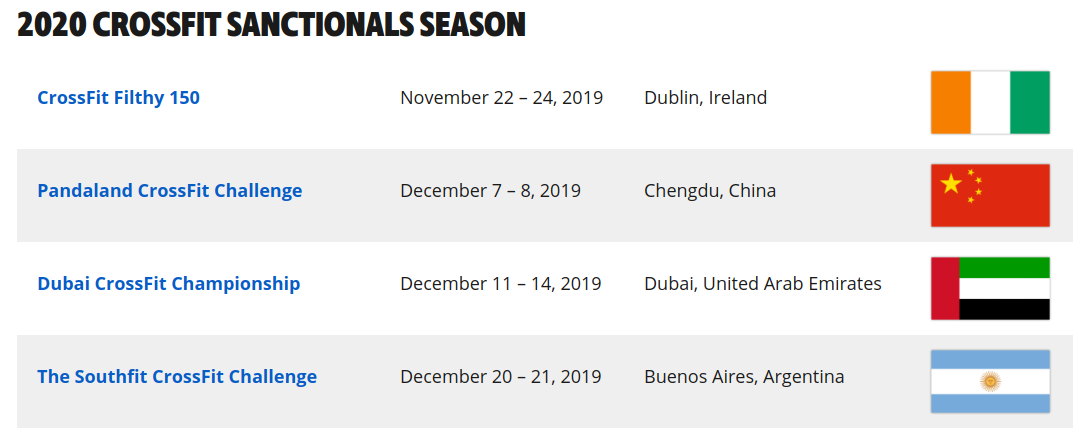
Today, CrossFit, Inc. announces the 2020 CrossFit Sanctionals™ season.
The season will kick off in November 2019 with the much-anticipated CrossFit Filthy 150 in Dublin, Ireland, directly following the 2020 Reebok CrossFit Open in October 2019. The season will conclude in Mexico at the Mayan CrossFit Championship during the first weekend in July. The 2020 CrossFit Sanctionals™ season will span the globe: 28 events in 21 different countries on six continents. From November to the following October, a CrossFit-sanctioned event will take place nearly every weekend somewhere around the world.
As in 2019, top finishers at each CrossFit Sanctionals™ event will receive invitations to compete against National Champions and the top 20 Open finishers at the 2020 Reebok CrossFit Games in Madison, Wisconsin.
These 28 independently owned and operated events represent the hard work, aspirations, and dreams of CrossFit affiliates, enthusiasts, volunteers, and athletes the world over. The majority of these competitions are long-standing events in their communities, with histories predating this new format. Each is a unique and particular expression of CrossFit’s universal methodology. Together, they represent CrossFit’s extraordinary and diverse international community.
The best way to enjoy a CrossFit Sanctionals™ competition is to participate in one. CrossFit is a participatory sport. Many sanctioned competitions have open categories for athletes of every ability. Others have robust team divisions. All need volunteers. All are welcoming. And all are eager to share their hard work and competitive vision with the worldwide CrossFit community. The Sanctionals™ have expanded the opportunities available to all who wish to express their fitness or enthusiasm in an officially sanctioned CrossFit competition.
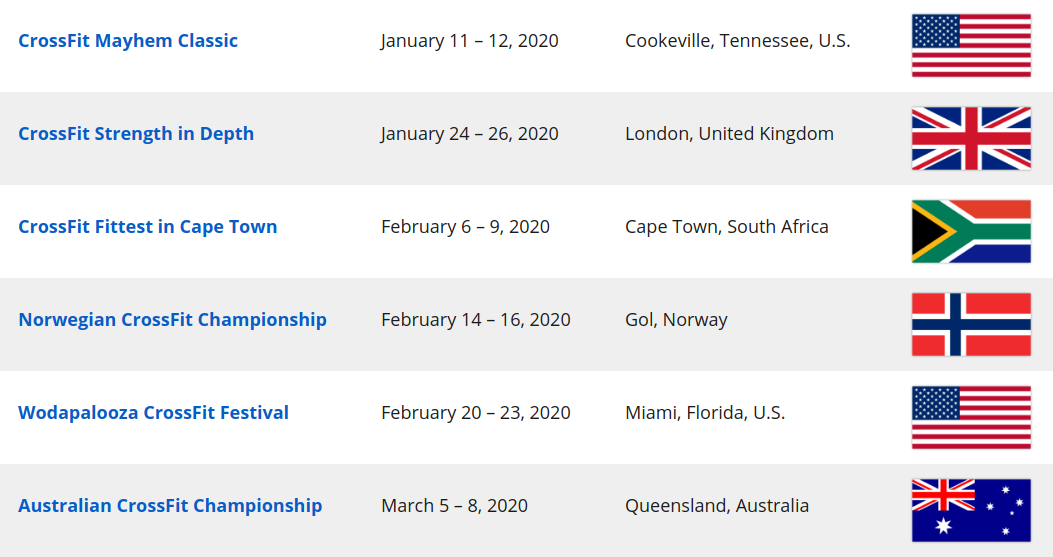
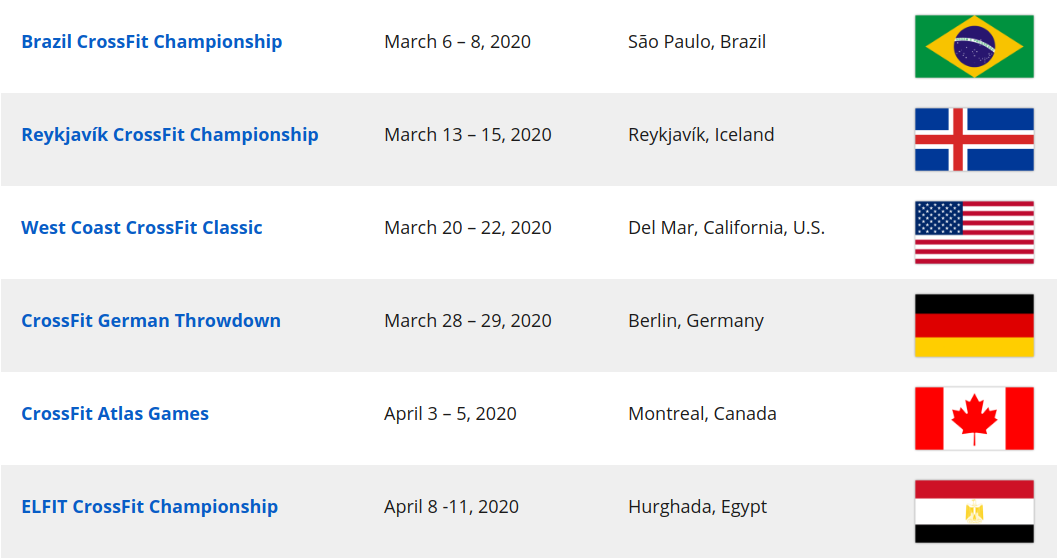

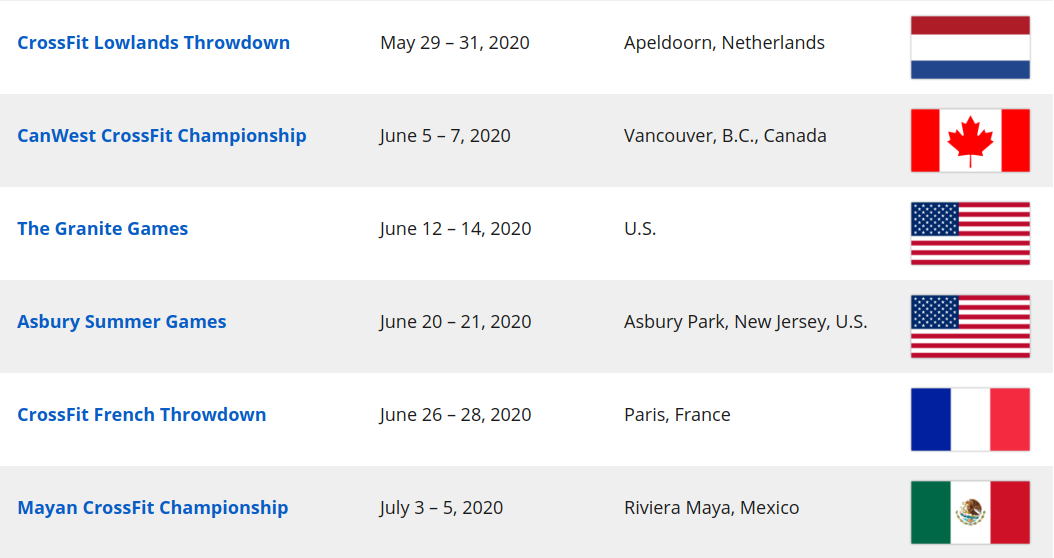
Article and Photo Taken from https://www.crossfit.com/sport/2020-sanctionals-season